Wednesday, March 20, 2013

Random Gallery - Yamfly

Random Butterfly Gallery
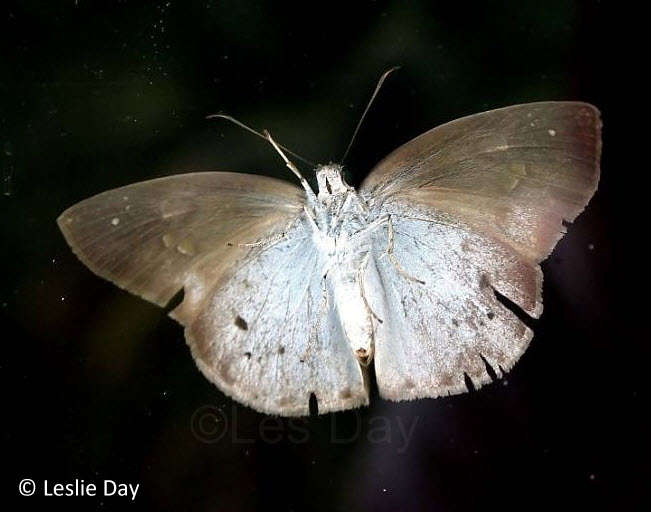
The Yamfly (Loxura atymnus fuconius)


In nature photography, and in particular butterfly photography, the result of a great shot is often a combination of knowing the subject, its habitat and environment, lots of patience and a good dose of luck! At times, it also depends on the photographer's ability to "see" beyond the obvious, and create quick compositions in his mind's eye, whenever an opportunity presents itself - even for a fleeting moment.

In this case, the artistic quality of this shot far outweighs the butterfly itself, because a photographer can seldom dictate the pose of his subject, nor determine exactly where it will land. The three curved leaves of the ferns draws the observer's eye towards the left and beyond the frame of the shot, but the subtle intersecting overlaps of the leaves suggest that they belong to the same plant, even though the main plant is out of sight. The butterfly sitting on the middle leaf gives a well-balanced composition to the shot, whilst its facing towards the left aligns with the directional curves of the leaves towards the left of the frame. The contrasting orange butterfly on the lime green background presents an eye-pleasing colour combination. A well-executed shot by ButterflyCircle member Sunny Chir. Never mind that the butterfly itself has lost one of its tails. In a perfect world, that would have been the icing on the cake that would make this an award-winning shot.


You have read this article with the title . You can bookmark this page URL https://butterflymuse.blogspot.com/2013/03/random-gallery-yamfly.html. Thanks!
Tuesday, March 19, 2013

Random Gallery - Yellow Palm Dart

Random Butterfly Gallery
The Yellow Palm Dart (Cephrenes trichopepla)


The Yellow Palm Dart is a relatively recent immigrant to Singapore and Malaysia. It is now quite widespread and found with regularity in Singapore, and in many states up north in Malaysia. This is an Indo-Australian species that found its way to SouthEast Asia probably due to human agency via the horticultural trade.

This interesting pose of a Yellow Palm Dart was taken by ButterflyCircle member Loke PF. The butterfly appears to be perched quite majestically on the young shoots of a plant, surveying its surroundings, all ready to take off on its high speed flight at a moment's notice.


You have read this article with the title . You can bookmark this page URL https://butterflymuse.blogspot.com/2013/03/random-gallery-yellow-palm-dart.html. Thanks!
Monday, March 18, 2013

Random Gallery - Blue Glassy Tiger

Random Butterfly Gallery
The Blue Glassy Tiger (Ideopsis vulgaris macrina)


The Blue Glassy Tiger is a common butterfly in Singapore, and is quite widespread in distribution. It is found in parks, gardens, mangrove areas and even in the nature reserves. As its caterpillar feeds on lactiferous "milkweeds" the butterfly is distasteful to predators. It is a model for other species to mimic for protection from predators.

This shot, taken by ButterflyCircle member Terence Kok, was taken at Pasir Ris Park's butterfly garden. It is feeding on the flower of Cosmos caudatus or commonly called the Ulam Rajah. The plant is a member of the Asteraceae family.  It is a popular herbal salad amongst the Malay community. The young leaves of the plant are eaten raw with sambal and the plant is believed to have medicinal properties.


You have read this article with the title . You can bookmark this page URL https://butterflymuse.blogspot.com/2013/03/random-gallery-blue-glassy-tiger.html. Thanks!
Saturday, March 16, 2013

Life History of the Common Snow Flat

Life History of the Common Snow Flat (Tagiades japetus atticus)


Butterfly Biodata:
Genus: Tagiades
Hübner, 1819
Species: japetus Butler, 1879
Sub-Species: atticus Fabricius, 1793
Wingspan of Adult Butterfly: 38-45mm
Caterpillar Local Host Plants: Dioscorea pyrifolia (Dioscoreaceae), Dioscorea glabra (Dioscoreaceae), and other Dioscorea spp.


Physical Description of Adult Butterfly:
Above, the wings are dark brown. On the forewing, there is a white hyaline spot in each of spaces 3,6,7,8 in both sexes, and additional spots in the female in spaces 4 and 5. These spots are larger and more distinct in the female than in the male. Darker brown discal/post-discal patches are found in spaces 1b to 8 and in the cell in the forewing. Similar but smaller post-discal patches are also found in spaces 1b to 6 in the hindwing. Underneath, the wings are pale buff brown and are similarly marked as per above. The underside of the hindwing is suffused with white scaling.


Field Observations of Butterfly Behaviour:  
This species is the most commonly found species of its genus in Singapore. They are typically found in forested areas of the nature reserves and other hill parks and wastelands. As is the case for the other Tagiades species, the adults have the habit of perching on the underside of a leaf between flights, and with its wings opened flat. The adults have the habit of visiting flowers and puddling on bird droppings.


Early Stages:
Several Dioscorea species have been found to be utilized by the early stages of the Common Snow Flat in Singapore, among them, the species Dioscorea pyrifolia has also been found to play host to the caterpillars of the Malayan Snow Flat and the Large Snow Flat. The caterpillars of the Common Snow Flat feed on leaves of the host plant. When not feeding, the caterpillar stays out of harm's way by confining itself to a leaf shelter formed by cutting and folding a leaf fragment along the edge of the leaf. 

Local host plant: Dioscorea pyrifolia.

A leaf shelter of a Common Snow Flat caterpillar found in the field.

The eggs of the Common Snow Flat are laid singly on the surface, typically on the upperside, of a leaf of the host plant. The orangy brown egg is hemispherical with its surface marked with longitudinal ridges running from the pole to the rim of the base. Each egg is well concealed in a mass of pale brown setae deposited by the mother butterfly.  The diameter (of its circular base) is about 1mm.

Two views of an egg of the Common Snow Flat.

Two views of a mature egg of the Common Snow Flat, with the head of the caterpillar partially emerged.

Two views of an empty egg shell of the Common Snow Flat.

The egg takes about 5 days to hatch. The young caterpillar emerges by eating away the polar part of the egg shell. The rest of the egg shell is not eaten by the newly hatched which is about 2.5mm in length. The pale yellowish body is roughly cylindrical in shape, and has a broad reddish lateral band running the entire body length. The head capsule is black and there is a dark brown to black collar mark on the dorsum of the prothorax. As the caterpillar grows, the body assumes a strong green to dark green undertone. After reaching about 5mm in about 3 days, the caterpillar moults to the 2nd instar.

Two views of a 1st instar caterpillar, length: 4mm.

The body of the 2nd instar caterpillar is yellowish brown with a green undertone. The head is dark reddish brown and bi-lobed. The dark collar mark on the prothorax is now less prominent. The lateral red bands are now less distinct and are pale red to pink in coloration. This instar lasts about 3 days with the body length reaching about 7.5-8mm.

Two views of a 2nd instar caterpillar, early in this stage, length: 4mm.


Two views of a 2nd instar caterpillar,  length: 6.5mm.

The 3rd instar caterpillar is pale yellowish/whitish with a green undertone. There is only a faint trace of collar mark on the prothorax, and the lateral red bands are now barely discernible. The head capsule is still black but broader sideways. There are numerous tiny, yellowish/whitish, speckles on the body surface . This instar takes about 3 days to complete with body length reaching about 12-13mm.

A 3rd instar caterpillar, length: 10mm.

The 4th instar caterpillar is little changed from the 3rd instar caterpillar, with the reddish lateral bands vanished entirely. This penultimate instar lasts about 4-5 days with body length reaching about 20mm.

Two views of a 4th instar caterpillar, length: 19.5mm.

The 5th instar caterpillar has similar body markings as in the 4th instar but the head capsule has taken a stronger reddish brown tone. The numerous yellow speckles dotting the body surface are rather prominent on the increasing weighty caterpillar. This final instar lasts for about 10 days, and the body length reaches up to 30mm.

Two views of a 5th instar caterpillar, in this stage, length: 28mm.

A close-up view of the head capsule of a 5th instar caterpillar.

On the last day of 5th instar, the body decolorises to a light shade of tea green. The caterpillar ceases feeding and stations within its leaf shelter. The pre-pupatory larva prepares for the pupal phase with a series of silk construction work with the main pieces being a silk girdle across the dorsum of its early abdominal segments, and a short and thickened transverse silk band on the substrate at  its posterior end. Both the dorsal point of the girdle and the transverse band are further secured by vertical/oblique threads to the inner wall of the shelter. Soon the pre-pupatory larva becomes dormant in its leaf shelter. Pupation takes place about 1 day later.

A pre-pupa of the Common Snow Flat in its pupation shelter.

The girdled pupa is secured with its cremaster attached to the short transverse band on the substrate. It has a short thorax, a rather long abdomen, a pointed rostrum and two small ear-like appendages at the leading edge of the mesothorax. The body is pale beige brown with two large triangular white patches in the wing cases, and smaller white lateral patches on the side of the abdominal segments. Length of pupae: 20-22mm.

Two views of a pupa of the Common Snow Flat.

After about 7-8 days of development, the pupal turns dark as the development within the pupal case comes to an end. The following day, the adult butterfly emerges from the pupal case.

Two views of a mature pupa of the Common Snow Flat.

A newly eclosed female Common Snow Flat.

References:
  • The Butterflies of The Malay Peninsula, A.S. Corbet and H.M. Pendlebury, 4th Edition, The Malayan Nature Society.
  • Butterflies of Thailand, Pisuth Ek-Amnuay, 2nd Edition, 2012
  • A Field Guide to the Butterflies of Singapore, Khew S.K., Ink On Paper Communications, 2010.
Text by Horace Tan, Photos by Benjamin Yam, Caijin Huang, Bobby Mun, Loke PK, Leslie Day, Federick Ho and Horace Tan
You have read this article with the title . You can bookmark this page URL https://butterflymuse.blogspot.com/2013/03/life-history-of-common-snow-flat.html. Thanks!
Tuesday, March 12, 2013

Random Gallery - Malay Baron

Random Butterfly Gallery
The Malay Baron (Euthalia monina monina)


The Malay Baron is one species that displays polymorphism in one of the sexes. In the case of this species, the males occur in three distinct forms, f-monina, f-gardineri and f-decorata. Often, a range of intermediates of these forms occur. The Malay Baron is largely a forest-dependent species and is predominantly found in forested areas in the nature reserves rather than in urban parks and gardens. 

This male f-gardineri Malay Baron was photographed at a park connector near a forested area by ButterflyCircle member Loke PF. The males of this species are robust and fast flyers, but often return to sunbathe on favourite perches. They are also known to feed on fermenting fruits on the forest floor. Females of this species are typically larger, often with 30% or more wing area compared to the males.


You have read this article with the title . You can bookmark this page URL https://butterflymuse.blogspot.com/2013/03/random-gallery-malay-baron.html. Thanks!
Saturday, March 9, 2013

Butterfly of the Month - March 2013

Butterfly of the Month - March 2013
The Magpie Crow (Euploea radamanthus radamanthus)


Our butterfly of the month for March is very impatient to be featured, so this blog article is coming out earlier than usual on this third month of 2013. As far as the wet weather is concerned, it's been warming up from the rainy days that we experienced in February. Though there have been really hot days, there are afternoon passing showers that can strike unexpectedly and then leave the rest of the day hot and extremely humid again.


Over here in Singapore, the government presented the budget for the fiscal year 2013 that spurred lots of debates from the residents - from coffee shops to corporate board rooms. Touted to be a progressive budget, the various packages affected practically everyone in Singapore, from individuals to businesses; Singaporeans and foreigners; singles and families. But like all things, not everyone will be pleased, and there will always be some disgruntled quarters.


The hotly-debated issues of congestion and crowdedness that grew worse in Singapore over the years continue to dominate social media websites, print media and formal and informal discussions all over the island. There have, however, been debates that border on racism, and coming from purportedly Singaporean netizens, this cannot be good for anyone in the longer term at all.


On the issue of the high cost of living, one sought-after commodity stands out prominently - car ownership. In Singapore, we have the unique Certificate of Entitlement (COE) system where one has to first procure a certificate to entitle one to own a car. It would appear like a logical solution to alleviate congested roads in Singapore, until one realises that to procure a piece of paper that is the COE may cost in excess of SGD90,000! In some neighbouring countries, that amount could land you a decently-sized house!


Speaking of neighbouring countries, the recent month-long incursion by armed Filipino Islamic militants is something that is virtually unheard of in recent years. The normally peaceful SouthEast Asian region was rocked with news of the clashes between the insurgents and the Malaysian police and military forces that left over 60 dead. Scores of followers of a self-proclaimed Philippine sultan landed in the state of Sabah on Borneo island last month to assert a long-dormant territorial claim in what has become Malaysia's worst security crisis in years. In military parlance, this could be well considered an invasion of sorts that would provoke retaliation of the highest order.


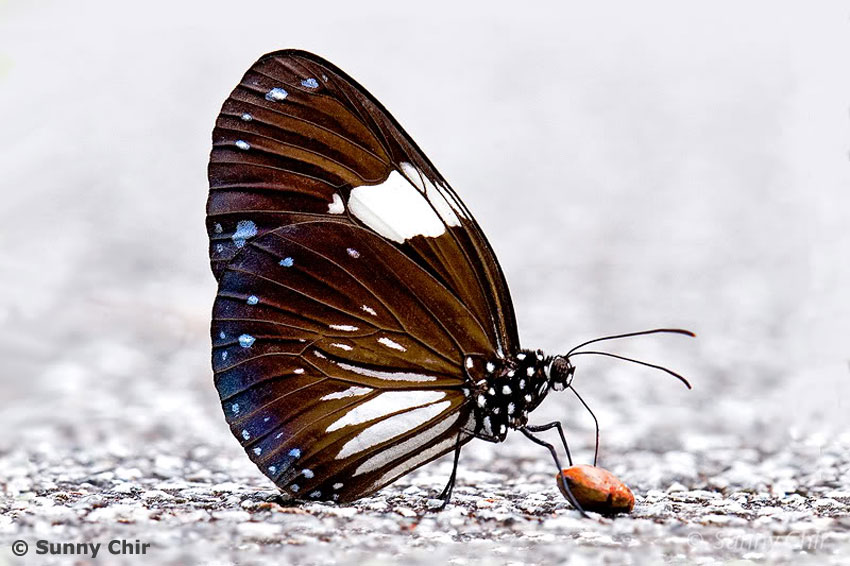
Let us leave the woes of the human world aside and come back to our butterfly of the month. For March 2013, we feature a Danainae species that is fairly common in Singapore and Malaysia, the Magpie Crow (Euploea radamanthus radamanthus) Although the butterfly cannot be described to be abundant, it is widespread in distribution and on some occasions, several individuals (usually males) were encountered in the same location. They are usually attracted to flowering trees e.g. Syzygium spp., damp wooden structures and decomposing organic matter.


Male Magpie Crows puddling on decomposing organic material on sandy streambanks

The Magpie Crow is so named, probably because of its black-and-white appearance, reminescent of the typical Magpie, a group of birds of the family Corvidae. The upperside of the wings of the Magpie Crow is bluish-black, with submarginal pale blue spots and white patches on the discal area of the forewings and long white streaks on the dorsal area of the hindwings. Males feature a pale blue brand on the forewings above.


The male Magpie Crow is by far the commoner of the two sexes, and appears in urban parks and gardens as well as in forested areas of the nature reserves. When attracted to either flowers or the pungent odours of decomposing organic material that it likes, the butterfly will often stay for a some time, circling around its target and repeatedly returning for a taste of its preferred 'cuisine'. Even when disturbed, it will stubbornly stay in the vicinity and return to the food source when the threat passes.


A male Magpie Crow puddles on the efflorescence from a plastered building

We have encountered the male Magpie Crow puddling on sandy streambanks which have been tainted by decomposing organic material, as well as damp timber structures. On one occasion, a male Magpie Crow was found feeding on the efflorescent salts from a plastered building. It was probably looking for the chlorides that were oozing out from the efflorecence. The butterfly also appears regularly when there are flowering trees where it feeds greedily on the flowers in the company of many other species of butterflies. The Magpie Crow is sometimes also partial to human sweat, and can be brazen enough to alight on an observer and stay to feed off the salts from a sweaty finger!


A male Magpie Crow feeds on the sweaty finger of ButterflyCircle member Les Day, quite brazenly confident that it will not be caught, killed and pinned in a collection.

The female Magpie Crow is rare, and appears almost brownish compared to the male's deep bluish-black colouration. However, the female sports larger areas of white, making it much whiter in appearance when it flies around. The submarginal spots on the female's wings are white, instead of pale blue as in the male. Females are more often encountered at flowering plants, or just flying around treetops and shrubbery. We have thus far not observed any female Magpie Crows puddling like the males.


Male Magpie Crow (top) and female Magpie Crow (bottom) : Compare the patch of white on the hindwings

The Magpie Crow flies slowly in an unhurried manner, but is often very skittish and alert to any intrusion into its space. Like many of its other related species in the genus Euploea (or commonly referred to as "Crows"), the Magpie Crow is believed to be distasteful to birds and displays aposematic colouration that warns would-be predators of its distastefulness. The early stages have not been recorded in Singapore yet, but the caterpillars are believed to feed on a lactiferous host plant.


Male Magpie Crow (top) and female Magpie Crow (bottom) : Note the colour of the submarginal spots on the wings - pale blue in the male and white in the female

It is noteworthy to mention that the two female forms of the rare Courtesan (Euripus nyctelius euploeoides) both mimic the male and female of the Magpie Crow for protection against predators. The female form-isina is a good mimic of a male Magpie Crow, with its bluer colour and smaller patches of white, whilst female form-euploeoides that has more extensive white patches on the wings and is pale brown, mimics the female Magpie Crow.


Text by Khew SK : Photos by James Chia, Sunny Chir, Chng CK, Federick Ho, Khew SK, Koh CH, Loke PF, Bobby Mun, Nelson Ong, Horace Tan, Mark Wong & Benjamin Yam

You have read this article with the title . You can bookmark this page URL https://butterflymuse.blogspot.com/2013/03/butterfly-of-month-march-2013.html. Thanks!
Tuesday, March 5, 2013

Random Gallery - The Courtesan

Random Butterfly Gallery
The Courtesan (Euripus nyctelius euploeoides)


The Courtesan is a rare species in Singapore, but makes regular appearances across the island from nature trails to urban parks and gardens. It is a species that displays sexual dimorphism - with the male appearing quite different from the female, including an obvious size difference and shape of wings. The female also exhibits Batesian mimicry in that both the two extant forms, f-isina and f-eupleoides mimic the male and female of the distasteful Danaid, the Magpie Crow.

Sightings of the females of the Courtesan are even much rarer, and this photo, taken by ButterflyCircle member Nelson Ong, features the f-eupleoides which is more often seen than the other form, f-isina. The caterpillar host plant of this species is Trema tomentosa a fairly common mid-sized tree that is found all over Singapore, but is never abundant.


You have read this article with the title . You can bookmark this page URL https://butterflymuse.blogspot.com/2013/03/random-gallery-courtesan.html. Thanks!